
Urochem 211
HIGH CHEMICAL RESISTANT POLYURETHANE SEALANT
SURFACE PREPARATION
The correct preparation of the joint faces is absolutely essential to the satisfactory performance of the sealant. All surfaces should be clean, sound, and dry, and laitance or surface contamination should be removed by thorough wire brushing, grinding or grit blasting. Vacuum or blow with compressed air to ensure thorough removal of dust. Metal surfaces should be free of mill-scale and rust and mild steel treated with a suitable anticorrosive primer.
DESCRIPTION
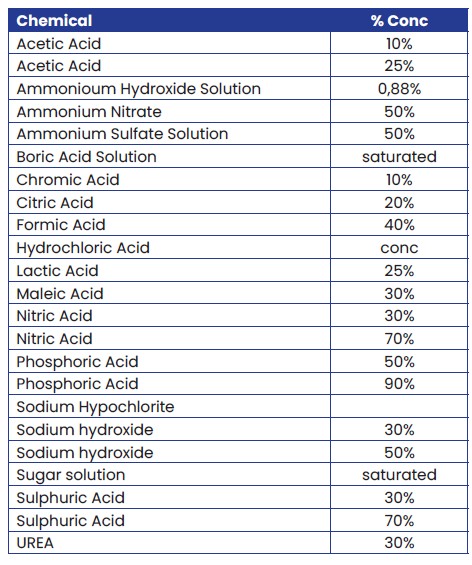
Urochem 211 is a two-component sealing compound based on a hydrophobic polyurethane resin and an isocyanate curing agent. The system crosslinks to produce a tough, durable rubber like seal. Its unique chemistry ensures that it is unaffected by high concentrations of acids, alkalis, and water-soluble salts.
APPLICATION
- Fill the sealant into a closed barrel gun using a follower plate or small trowel. Gun into the joint using a continuous squeezing of the trigger to ensure a smooth continuous flow of material.
- Fill the joint from the bottom up and ensure that there is contact between the sealant and joint surfaces.
- To ensure contact of the sealant with the walls of the joint, the sealant should be tooled to a smooth finish using a rounded spatula. A soapy solution may be used to aid the process. Remove any masking tape applied before cure has commenced.
PRODUCT APPLICATION
Typical applications include its use in both vertical and horizontal joints in bonded areas designed to contain chemical spills, sewerage treatment plants, sumps, laboratories, and chemical manufacturing plants.
JOINT DESIGN
- The recommended minimum joint dimension is 6 x 6mm, but where possible we recommend a 10 x 10mm joint.
- For joints ranging from 6mm to 10mm wide, we recommend a width to depth ratio of 1:1, for anything wider a 2:1 width to depth ratio should be maintained.
- In water retaining structures a 1:1 ratio should be maintained due to Hydrostatic pressure and cyclic movement.
- These ratios provide the optimum geometry to allow movement to occur within the joint without placing excessive force on the joint faces.
- Joint faces should be parallel, and the joint width should be at least four times the anticipated movement.
- When placing the sealant, the joint opening should if possible be central to its maximum compression/expansion cycle.
MIXING
- Urochem 211 is supplied in a two-part kit, base, and activator in separate tins.
- Transfer the total quantity of activator into the base component and mix thoroughly using a slow speed electric drill fitted with a flat blade stirrer.
- Scrape down the sides of the can and the base and remix until the colour is uniform and free from streaks.
- Thorough mixing is essential and should take 5 to 10 minutes.
BOND BREAKER
To ensure proper movement of the joint a bond breaker must be used at the base of the joint. Where a backing material such as polyethylene foam rod is used to ensure the correct joint geometry a bond breaking tape is not required. For water retaining structures care must be taken to comply with design requirements.
CLEANING
Clean all tools and equipment with Urochem 901 before setting of the sealant has taken place.
SAFETY
Contact with skin should be avoided by wearing gloves and protective clothing. In case of eye contact wash well and obtain medical advice.
TYPICAL PROPERTIES
Mixing Ratio
Two component – mix as supplied – Do not part mix
Pot Life
20 Min @ 25° C
Tac free
1 Day
Full Cure
7 Days
Colour
Grey – Other colours available
Density
1,49 g/cm³
Hardness
± 35 – 40 Shore A
Movement Accommodation
15%
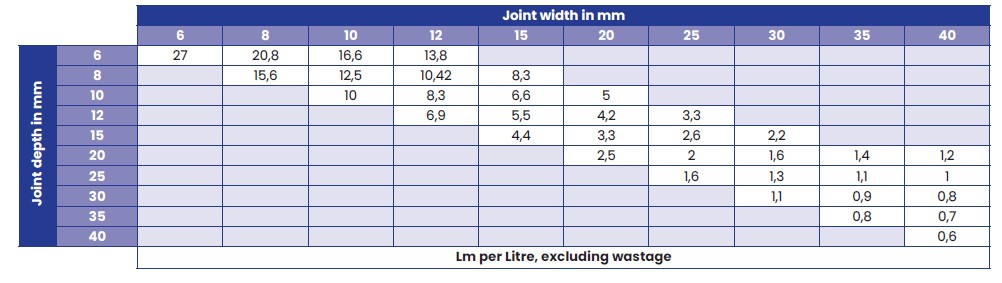
Theoretical coverage
See Material Estimating Guide below
Chemical resistance
Most acids, alkalis & salts
Shelf Life
9 Months
Application Temp.
5 – 35°C
Service Temp.
-25 – 90°C
Pack Size
2 Lt Kits
Cleaning
Urochem 901
Storage
Store in a cool dry well ventilated place away from heat & sunlight
MATERIAL USAGE ESTIMATING GUIDE
(No allowance made for wastage)
CHEMICAL RESISTANCE CHART
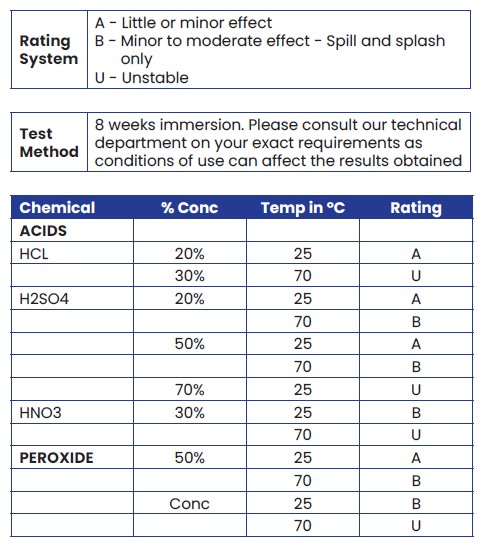
CHEMICAL COMPATIBILITY CHART